Freight forwarders are extending customer support hours by partnering with offshoring companies that provide dedicated remote teams for shipment tracking, customer inquiries, documentation, and after-hours operations. This customer support outsourcing model enables 24/7 coverage without hiring additional local staff or increasing overtime costs.
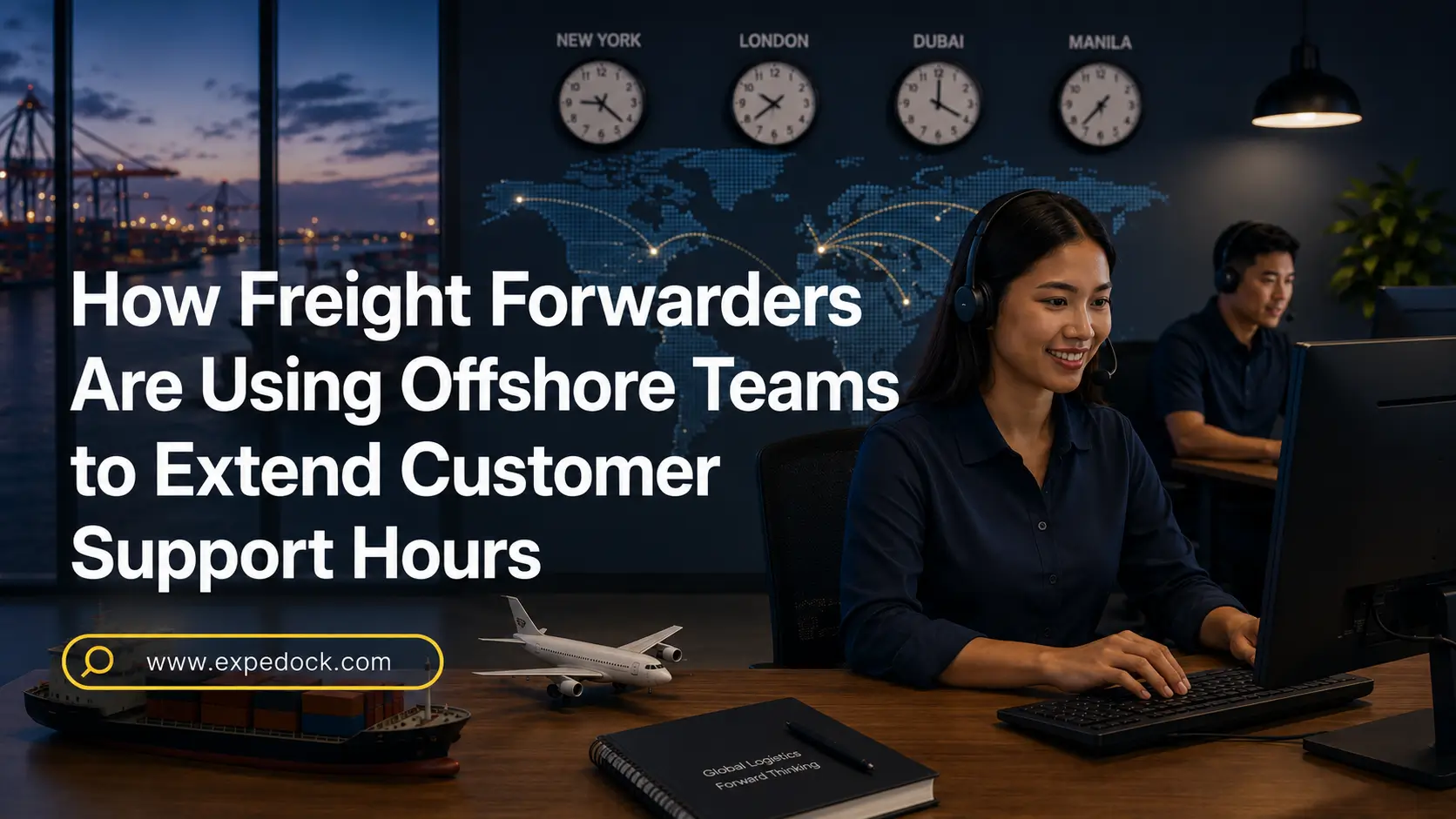
Customers no longer operate on a 9-to-5 schedule. Neither do supply chains.
A shipment delayed in Shanghai can impact a consignee in Germany overnight. A customer in Los Angeles may need an urgent update while your office in London is already closed. For freight forwarders, this creates a growing challenge.
How do you provide around-the-clock customer support without dramatically increasing payroll? The answer for many logistics companies is surprisingly simple: offshore teams.
Today, leading freight forwarders are partnering with offshoring companies to extend customer support hours, improve response times, and create true 24/7 operations. And contrary to common misconceptions, this isn't simply about reducing costs. It's about building a more responsive, resilient, and scalable business.
Freight forwarding has become an always-on industry. Customers expect:
But many logistics companies still rely entirely on local teams. This often leads to:
As global trade accelerates, these challenges become increasingly difficult to manage with local staffing alone.
Forwarders are discovering that extending customer support doesn't require building larger offices. Instead, they're leveraging outsourcing staff strategically to create distributed operations.
By placing teams in different time zones, companies can continue supporting customers while local offices are offline. This model allows businesses to:
Most importantly, customers experience continuous support without noticing where the work is being completed.
Not every role should be offshored. However, many customer-facing support functions are ideal candidates.
Remote teams proactively monitor shipments and provide updates on:
Customers receive faster answers without waiting for local teams to start their day.
Offshore specialists can manage:
This significantly reduces response times.
Teams can prepare and distribute:
This keeps shipments moving even after local offices close.
Offshore teams can identify:
Critical problems can be escalated immediately.
The most effective structure is known as a follow-the-sun model. Here's how it works:
When local offices close, offshore teams continue processing work. When local teams return the next day, much of the operational backlog is already complete. The result is seamless service continuity.
The advantages go far beyond availability.
Customers receive answers in hours instead of waiting until the next business day.
Proactive communication builds trust and strengthens relationships.
Local teams spend less time working late nights and weekends.
Documentation and support requests are processed continuously.
Support capacity can expand without significant local hiring.
Not all providers are built for logistics. When evaluating offshoring companies, look for:
Your partner should already understand:
They should be comfortable working inside:
Ask:
Your provider should support:
Avoid providers that constantly rotate personnel. Consistency matters. Customers value familiarity and continuity.
Modern customer support outsourcing is no longer labor-intensive. AI tools now assist offshore teams by:
Humans then validate information, communicate with customers, and resolve issues.
The result is: AI for speed + humans for empathy + offshore teams for scalability.
Many companies assume customers prefer local support teams. In reality, customers prioritize three things:
They rarely ask where the support team is located. They care about outcomes. When executed correctly, offshore teams become invisible to customers and invaluable to operations.
Freight forwarding is no longer a business that pauses overnight. Customers expect support whenever problems arise, regardless of time zone. That's why leading forwarders are partnering with offshoring companies to extend customer support hours without increasing local headcount.
By strategically using outsourcing staff and customer support outsourcing, companies can:
The future of logistics customer support isn't about working longer hours. It's about building smarter operating models. And increasingly, offshore teams are becoming a critical part of that strategy.
